The Science & Religion Debate
Having grown up in a family of scientists (with two PhD’s) and with a Physics Honours degree, I consider myself scientifically inclined with religion merely serving as a cultural backdrop in my life.
Leaving one of my Physics class on a beautiful spring day in 1969, I had an epiphany about science explaining everything which made God and religion redundant. I vividly remember the warm glow and the sense of wonder I felt at this triumphant insight.
But then I grew up! My simplistic worldview of youth gradually evaporated in the starkness of life’s complexities. By the time I turned 50, around the change of millennium, my comfortable certainty about science had been replaced by a gnawing uncertainty about almost everything. All misconceptions of my youthful all-knowing cleverness had now morphed into the wisdom of scepticism. I found myself increasingly drawn to the Big Questions of science and spirituality to make some sense of life only to be thwarted at each turn. The question that forever engaged my attention now was if we could really know anything with certainty at all?
With this state of mind, I was surprised when I came across the unabashed certainty of The God Delusion, a 2007 book by Richard Dawkins the British evolutionary biologist. In the book Dawkins savagely, attacked religion and belief in God. The book was more a polemic hit piece than a scientific or even a philosophical critique of the subject matter. While Dawkins made some valid points, his hateful, overzealous and self-righteous narrative totally undermined his arguments making him guilty of the same extreme orthodoxy he was castigating religion for.

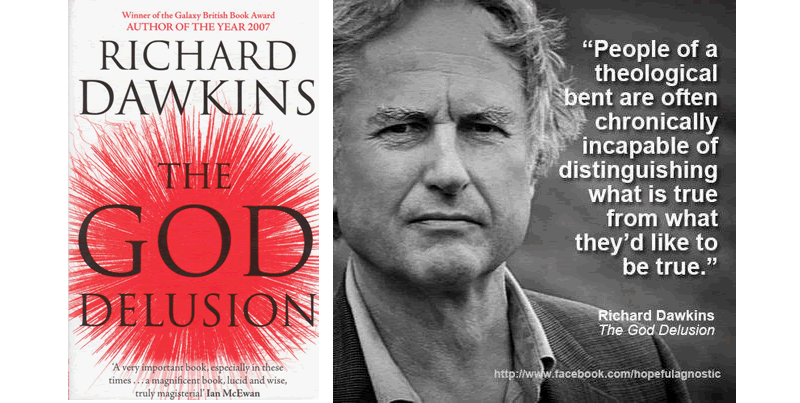
After some careful analysis I realised that the books tone and rationale weren’t accidental but were cynical attempts to sell a point of view which could be explained by the following reasoning:
- Like the blind men attempting to know what an elephant looked like, Dawkins had got hold of the tail of the Belief Elephant where he was in the unfortunate position of being exposed to nothing but elephant excrement which became the basis of his views about religion. A victim of his own arrogance he took that to be the whole reality totally missing the majesty and the grandeur of the Truth.
- Radical, divisive, negative and extreme views attract quick and greater attention than moral pronouncements. It was easier for Dawkins to gain power, influence and wealth through a controversial and populist book than would have been possible if he had written a balanced, well-considered, deep, thoughtful and perhaps boring scientific treatise.
For each one of Dawkins criticism of religion I could easily present one against science which in no way invalidates science. Nor does Dawkins tirade against religion specially when it comes from a position of populism, bias or ignorance. So, if Dawkins extreme views are to be rejected where does the truth lie in this debate? Let us consider some basic questions in an effort to find the truth.
What does Science and Religion mean?
Definitions are integral to discussing any topic so let us start with my simple definition of the two terms as;
Science – is the systematic study of our material reality through observation, experiment and deduction.
Religion – is the system of beliefs about our immaterial reality which are realised through study, introspection and discourse.
The definitions make it obvious that Science and Religion deal with entirely different realms. Frequently science needs beliefs bordering on religiosity to explain unverified phenomena like life, consciousness, anthropic principle, origin of the universe, quantum mechanics etc. However, there is no similar reverse overlap by science. In a seemingly child like petulance Science has unilaterally rejected the validity of religion without offering any explanation for this rejection based on its much vaunted Scientific method.
Despite the supposed antagonism there are some undeniable commonality between the two in that they both profess to be trying to discover the truth, are based on a set of beliefs, evolve over time and strive for the greater good of humanity.
What is the relationship between Science & Religion?
I consider the relationship between the two to be that of a parent and child. It was religion which after humanising and civilising mankind, gave birth to science. This is supported by the fact that religion has always existed whereas the origins of the current form of science can only be traced back to the last few hundred years.
With the vigour of youth, science is brash, arrogant, clever and outward looking while religion with the burden of age is slow, humble, wise and inward looking.
In his excellent book Rock of Ages: Science and Religion in the Fullness of Life, American evolutionary biologist Stephen Jay Gould describes science and religion as “non-overlapping magisteria” where he suggested that both science and religion deal with fundamentally separate aspects of human experience which co-exist peacefully in their own domain.
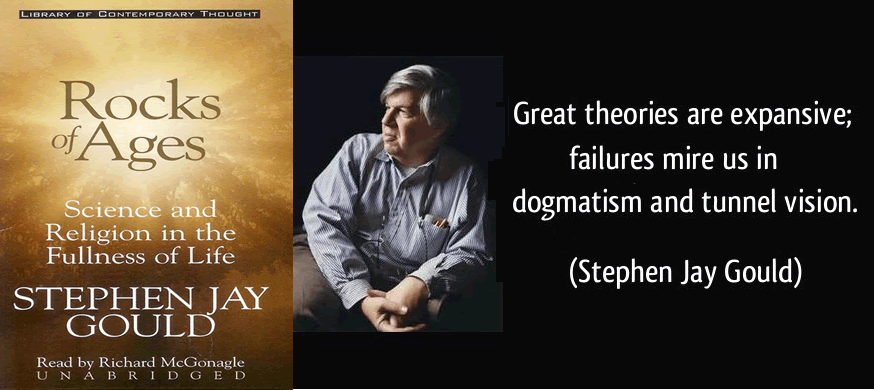
I strongly relate to this as it was also my experience growing up in a family of four scientists where our religious beliefs coexisted in perfect harmony with our scientific worldview. The clear boundaries of religion with their traditions, rituals and mythology were never crossed in defiance of reason. This in no way was unique to me but was also the broader consensus amongst almost everyone I knew.
However, this does not stop people from being exploited in the name of religion. But is this exploitation any different to the exploitation carried out in the name of commerce, politics, race, nationality or sex? Isn’t exploitation a civilisational affliction independent of any system of beliefs? Doesn’t Science exploit not only humanity but the whole planet for its narrow gains? I highly doubt if Richard Dawkins would be willing to condemn Science with equal vehemence in the face of evidence proving its malevolence!
Why the Debate and Conflict?
The conflict between Science and Religion is based on a fallacious debate where the combatants, like politicians, are vying for power and influence for their vested interest and personal gains.
The main reasons for almost all the conflicts are always the same and can be boiled down to wealth, power or ideology. These elements are also in play in the conflict between Science and Religion which is kept alive by stoking controversy, debate and division.
When religion was dominant it tried to suppress science and now that the roles have been reversed science is returning the favour. It is interesting to note that both use the same tools of propaganda, political power, self-righteousness, social justice, hollow slogan of greater good and fear to assert their dominance.
What the critics of religion rarely acknowledge is the fact that the bulk of the scientific progress, on which its current success is based, is mainly the result of work by scientists who were ardently religious. This fact roundly disproves another baseless claim by Richard Dawkins that “religion debauched scientific enterprise”.
Here are some examples of famous scientists who were religious,
- Issac Newton – Considered the father of modern science
- Galileo Galilei – In whose name science condemns religion.
- Gregor Mendel – The founder of modern science of genetics
- Charles Darwin – The folk hero of atheists, touted as the person responsible for destroying religion. In reality Darwin was a religious person for most of his life and only questioned his faith towards the latter part of his life. It is obvious that his religiosity did not in any way interfere with his scientific endeavours which resulted in his “On the Origin of Species”
Science hustlers like Dawkins distort the facts to prove their point. They use opposition to the church, its teachings or its interpretation of God as evidence of rejection of religion. But is it really, considering that every religious reform has been driven by people who opposed and challenged the established dogma?
Devout people like Martin Luther, Tolstoy and Gandhi always challenged their church and religion, sometimes at great personal risk. Rejecting an interpretation of God or religious orthodoxy does not amount of rejection of religion. Why else would all true religion warn against the dangers of blind and mindless faith?
Does any challenge to established scientific principles or theories disqualify a person from being identified as a scientist? If true than it would definitely disqualify Einstein and Niels Bohr from being called scientists because they totally upended a number of long established scientific theories!
Both science and religion are distinct stages of the same linear path of human evolution. Trying to saw the seed of discord between the two is tantamount to saying that there is a conflict between the root and trunk of a tree. If roots represent belief, the trunk which is its visible external manifestation represents reason. The healthier the roots, the more fruitful the tree. Both go hand in hand to nourish the tree of life. While destroying the trunk might not kill the tree destroying the roots certainly will!
Who is right?
Both religion and science are essential and right in their own domain. However, settling this debate on this basis does not serve the power brokers in both camps. In the same way as the military industrial complex needs frequent wars to find an outlet for their production to continue, the Scientific and Religious establishment also needs an ongoing conflict to feed their appetite for power, influence and wealth.
We have become so dazzled by the benefits bestowed by scientific progress that we may have become blind to the civilisational train wreck we might be heading for on the back of science and technology. Shouldn’t we slow down, take a breath and carefully consider if we are going to our preferred destination?
Doubt has always existed along with belief in the same way as darkness with light. This important fact is duly acknowledged in the Bible in the character of Doubting Thomas. However, what is easily overlooked is the fact that darkness, which is nothing but absence of light, has no independent existence without light. Same with doubt which is nothing but the absence of faith. In its effort to destroy religion, a system of beliefs which has evolved over thousands of years and nourished civilisation, science is hollowing the very foundation on which it is built.
The excesses of religious authoritarianism and extremism, both past and present, have had such a deep impact on human psychology that it has blinded us to the far greater dangers of unfettered scientific monopoly. We will compare and evaluate the harmful effects of both science and religion in future blogs.
Is there a danger of Science turning malevolent?
Power corrupts, and absolute power corrupts absolutely. This dictum was true for religion in the past and is true for science today. For every religious persecution of Galileo and Giordano Bruno there are many similar victims of scientific heresy who were made to pay a heavy price for their challenge to the established scientific orthodoxy.
These victims of science are in every field of scientific endeavour including climate science, string theory and cosmology. The Black Hole War by physicist Leonard Susskind is an excellent book which illustrates the challenges he had to overcome over years to reverse some fundamentally wrong pronouncements made by Stephen Hawking, the uncrowned Pope of the Black Hole sciences.
Finally, when the choice is between the wisdom of Einstein and the rantings of Dawkins on the matter of Science and Religion, I think we can safely go with Einstein who in his 1941 article titled Religion and Science said “a legitimate conflict between religion and science cannot exist. Explaining his reasoning he added that “ Even though the realms of religion and science in themselves are clearly marked off from each other, nevertheless there exist between the two strong reciprocal relationships and dependencies. Though religion may be that which determines the goal, it has, nevertheless, learned from science, in the broadest sense, what means will contribute to the attainment of the goals it has set up. But science can only be created by those who are thoroughly imbued with the aspiration towards truth and understanding. This source of feeling, however, springs from the sphere of religion. To this there also belongs the faith in the possibility that the regulations valid for the world of existence are rational, that is, comprehensible to reason. I cannot conceive of a genuine scientist without that profound faith. The situation may be expressed by an image: Science without religion is lame, religion without science is blind.
Any system with unabated power and influence turns malevolent not due to some systemic failure but due to the inherent flaws of arrogance, greediness and selfishness in human psyche. If this is true than we should guard against the risks of the corruption of science unless we believe scientists to be a different breed of beings, free of common human frailties. The real debate should not be about Science and Religion, which is a distraction, but about human frailties and their almost infinite capacity for corruption?
Muse
- Do we personally experience any difficulty keeping our religion or beliefs from clouding our reason?
- Should we lightly accept anyone’s claim of absolute knowledge on a matter which has been inconclusively debated for thousands of years?
- Why the aggressiveness and name calling in the debate? Isn’t this the last resort of the ignorant or scoundrel?
- Why can’t Science in its stated aim to find a Theory of Everything incorporate Religion in that quest?
- Can Science be evil? Where is the coverage for Evils perpetrated by Science?
- Is Science getting a free pass due to our preoccupation with the past and current evils carried out in the name of religion?
- Might there be a case for separation of State and Science in the same way as for State and Religion?
Next Week: Climate Change
