Defining Truth
Truth is yet another term which is difficult to define. One of the first efforts to define it was made by Anselm of Canterbury (c. 1033 – 1109) in his medieval work De Veritate where he wrote “I do not recall ever having found a definition of truth” and went on to define truth as “rightness perceptible only to the mind.”
Again, like most commonly used terms there are several definitions of Truth, either limited in their scope or too complex to be easily understood. I reject the notion that a fundamental term such as Truth should be either complex or beyond reach and suggest the following simple definition:
“Truth is that fundamental attribute of existence which is the source of harmony with our environment and essential for our progress and wellbeing. It is the vehicle through which we achieve and experience wisdom, love, beauty, joy, success, health and happiness.”
Thoughts or actions which bring peace, love, harmony, contentment, health etc. in our lives are intuitive and reliable signposts for Truth. Nobel Laureate Rabindranath Tagore in his book Sadhana describes Truth beautifully as follows:
“Facts are many, but the truth is one. The animal intelligence knows facts, the human mind has power to apprehend truth. The apple falls from the tree, the rain descends upon the earth—you can go on burdening your memory with such facts and never come to an end. But once you get hold of the law of gravitation you can dispense with the necessity of collecting facts ad infinitum. You have got at one truth which governs numberless facts. This discovery of truth is pure joy to man—it is a liberation of his mind. For, a mere fact is like a blind lane, it leads only to itself—it has no beyond. But a truth opens up a whole horizon, it leads us to the infinite”.
This also explains why people often get confused with relativistic claims of “My truth” and “Your truth”. Truth is singular and never relative or divisible. Any perception to the contrary merely reflects the limitations of our knowledge.
Satyam Shivam Sundaram is a very popular Hindu Vedantic chant used across the length and breadth of India which literally means Truth, God, Beauty. Having grown up with the chant, it creates a sense of peace and tranquillity in my heart without the need for consciously interpreting its meaning. However, putting on my Muse hat I interpret the order of the three words as an exhortation to give Truth (Satyam) precedence over our search for God (Shivam) and Beauty (Sundaram). I also take the chant to be a commandment to exercise reason, an essential tool for discovering the Truth, over blind faith in God.
Hinduism recognises Truth at the core of our existence and considers it as “that which is beyond distinctions of time, space, and person and pervades the universe in all its constancy“. This primacy of Truth is also acknowledged in the Indian national motto “Satyameva Jayate” (Truth alone wins).
When pursued intellectually Truth is found at the apex of a pyramid of information, facts, knowledge and wisdom which act as the stepping stones to the Truth. Failure to recognise this results in mistaking information, facts and knowledge as the Truth which deprives us from its real benefits.
On the other hand, intuitive path to Truth involves NO seeking. Truth reveals itself to all those willing to orient their lives to its manifestation in their life through virtue, morality and purity of intent.
Spirituality and religion also hint at this alternative path for discovering the Truth. German author Hermann Hesse in his book Siddhartha illustrates the point by highlighting the importance of intuition and nature for achieving Nirvana (Enlightenment – the ultimate Truth) with the following words:
“I don’t differentiate much between thoughts and words. To be honest, I also have no high opinion of thoughts. I have a better opinion of things. Here on this ferry-boat, for instance, a man has been my predecessor and teacher, a holy man, who has for many years simply believed in the river, nothing else. He had noticed that the river spoke to him, he learned from it, it educated and taught him, the river seemed to be a god to him, for many years he did not know that every wind, every cloud, every bird, every beetle was just as divine and knows just as much and can teach just as much as the worshipped river. But when this holy man went into the forests, he knew everything, knew more than you and me, without teachers, without books, only because he had believed in the river.”
Everyone is instinctively programmed to assimilate the Truth in the same way as our body assimilates essential nutrients from our food without the need for any conscious effort or awareness. Truth like nutrients has the fundamental property of nourishing and nurturing with the additional all-important attribute of enlightenment.
However, due to our ever-increasing preoccupation with materialism and its overwhelming emphasis on intellect (Original Sin!) the power of intuition has been totally diminished in our lives. What should have been a partnership of equals has degenerated into a monopoly of the intellect to the great disadvantage of a majority of people who are not intellectually inclined.
Despite this each one of us has the freedom to choose any one of the following two paths to the Truth:
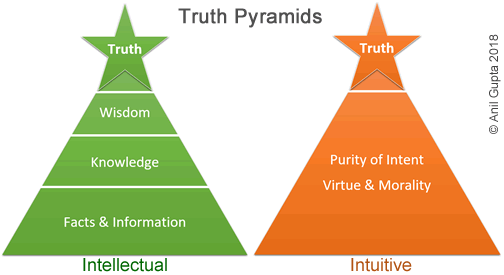
In the same way as a rough diamond needs to be polished to remove layers of impurities and imperfections to reveal it in its full glory the Truth, when sought intellectually, needs to be similarly expunged of layers of subjectivity, misinformation, arrogance, emotion, ego, greed etc.
Truth brings coherence in our lives by harmonising it with our physical, spiritual and social environment, resulting in a sense of joy, peace and tranquillity. We know we are on the path of truth if our actions lead us towards these attributes. Absence of these in our lives indicates that we are living in the shadows or darkness of falsehood.
And why is the pursuit of truth important and where does it lead us? I believe that it leads us to the ultimate Reality or Truth, which manifests itself as infinite wisdom, love, beauty and joy. Theists call it God and atheists Nature or Nirvana, all ultimate and worthy goals for a good and meaningful life.
Muse
- Is pursuit of happiness inexorably linked to the goal of seeking the Truth?
- Could an honest stock taking of Truth in our life serve as a barometer of success and happiness?
- Does the phrase “Truth is God” have any practical meaning?
- Are different perceptions of truth manifestations of the one Truth?
- Is mindfulness a way of invoking our intuition for the discovery of the Truth?
Next Week – Belief Elephant
